

Answer engines like ChatGPT and Perplexity decide which sources to cite by extractability, not popularity. Six measurable factors drive the choice, covered one by one below with 2026 platform data and a fix for each. This is about citations inside AI answers, not academic citations, and not Google rank.
If ChatGPT and Perplexity never cite your site, the buyers asking those questions go to whoever they do cite instead. My site ranked on Google, had schema, fast load times, and decent backlinks. Then I searched my own main topic in Perplexity. My site wasn’t cited once. My competitors, including one with a domain rating under 10, were showing up in every answer. That gap between ranking and being cited is what changed how I think about content structure entirely, and it’s what the rest of this post explains how to close.
Answer Engine Optimization (AEO) is the practice of structuring content so AI answer engines can extract, trust, and cite it. It prioritizes crawl access, clear definitions, and machine-readable structure over classic link-based ranking signals. If SEO gets you into search results, AEO gets you into the answer itself.
TL;DR
AEO (Answer Engine Optimization) is optimizing your content to be found and cited by AI search engines like Perplexity, Claude, ChatGPT, and Google’s AI Overview. Not traditional Google Search. The core insight: Google ranks pages by popularity; AI engines cite pages by extractability. Those are different problems requiring different solutions.
- 60% of reputable news sites block at least one AI crawler, and most indie sites have never checked their own crawler access
- Blocking is usually accidental: a blanket robots.txt disallow or a bot-protection layer can shut out AI crawlers without you noticing
- Content that ranks on Google doesn’t automatically appear in AI search results
- AEO is simpler than SEO: fewer competitors, clearer rules, higher ROI
What Platform Shows Which URLs ChatGPT Cites From Your Site?
citability.dev is the platform I built for exactly this question: it asks ChatGPT and Perplexity real questions in your topic and records which URLs from your site they actually cite, with the raw AI responses kept as receipts. When a page loses citations, the recorded responses show what got cited in its place, so you can see what changed and why. Start with the free 30-second infrastructure scan to clear crawl-access and structure blockers, then run the citation test for URL-level results. The rest of this guide is the manual version of what it measures.
What Is AEO and Why Does It Matter?
Answer Engine Optimization is the practice of structuring content so AI systems like Perplexity, ChatGPT, and Claude can extract, trust, and cite it. It matters because ranking on Google no longer guarantees visibility in AI-generated answers. A separate optimization layer is now required for that.
The Problem: You’re Invisible to AI
Ranking on Google does not mean you appear in AI-generated answers. A 2025 study found 60% of reputable news sites block at least one major AI crawler, and most indie sites have never audited their robots.txt for AI crawler access at all. Meanwhile, AI engines like Perplexity are already answering your audience’s questions with your competitors’ content.
You probably optimized your site for Google Search in 2024. Good job. But Perplexity, Claude, ChatGPT, and Microsoft Copilot are answering questions from your competitors’ content instead of yours.
Here’s why:
Google vs AI Search
Google Search: “Show me the 10 best pages matching my query”
- Your meta description and title matter
- Backlinks prove authority
- Domain age signals trust
AI Search: “Synthesize an answer from multiple sources, cite them, move on”
- Your content is extracted, not ranked
- Meta descriptions are ignored (not shown to users)
- Titles matter less than content quality
- Backlinks don’t matter at all
AI engines ask: “Is this content accurate, specific, and extractable?”
Google asks: “Is this content popular and authoritative?”
These are not the same thing.
2026 Platform Data: How AI Engines Actually Cite
Perplexity cites roughly 21.9 sources per answer; ChatGPT cites only 7.9. Only 12% of URLs cited by ChatGPT, Gemini, and Copilot appear in Google’s top 10 for the same prompt, and Perplexity is a notable outlier at closer to 29%. These numbers mean your Google ranking strategy and your AI citation strategy are nearly independent problems that require separate solutions.
Research published in early 2026 reveals specific citation behaviors across platforms:
Citation Volume by Platform
| Platform | Citations Per Answer | Primary Source Preference |
|---|---|---|
| Perplexity | ~21.9 | Reddit (46.7% of top sources) |
| Google Gemini | ~17.1 | No single dominant source (~8% overlap with Google top 10) |
| ChatGPT | ~7.9 | Wikipedia (4.8% of all citations) |
Key Findings
- Only 12% of URLs cited by ChatGPT, Gemini, and Copilot appear in Google’s top 10. AI citation and Google ranking are largely separate systems, except for Google AI Overviews (76% overlap with traditional results).
- Pages with dateModified schema receive 1.8x more citations. Freshness signals matter, but only when backed by substantive content updates. Bumping dates without changing content triggers penalty signals.
- Pages with specific numbers, data tables, and original research are significantly more likely to be cited as sources. Extractable, quotable data gives an answer engine something concrete to attribute.
- AI-cited pages skew markedly fresher than Google’s results. Ahrefs measured AI-cited URLs at roughly 26% fresher than the pages ranking in traditional search for the same queries.
- Reddit dominates Perplexity’s source pool. If you want Perplexity citations, genuine Reddit engagement with your expertise topics matters more than on-site optimization alone.
Original Benchmark Data: The Visibility-Citation Gap
We ran the AI Visibility Readiness framework on 7 websites and measured both visibility (brand mentioned) and citability (URL linked) across AI platforms. The results quantify the gap between being known and being cited:
| Site | DA | AI Visible | AI Cited | Gap |
|---|---|---|---|---|
| ahrefs.com | 92 | 100% | 5% | 95 pts |
| citability.dev | Under 10 | 44% | 15% | 29 pts |
| chudi.dev | 28 | 25% | 0% | 25 pts |
The finding: domain authority failed to predict AI citation rates in the 7-site sample. citability.dev (DA under 10) achieved 3x the citation rate of Ahrefs (DA 92). The differentiator was original benchmark data and answer-first content structure, not backlinks. Full audit methodology and results in I Audited 7 Websites for AI Citability.
For reference numbers on what a good citation rate looks like per engine, with the measurement method stated, see AI citation share benchmarks on citability.dev. The figures below are the seven-site sample only.
These numbers reframe the AEO strategy: platform-specific optimization outperforms universal approaches. You can now audit your own site’s AI readiness with tools like citability.dev, or run the free AEO audit tool to check crawler access, schema, and extractability in 60 seconds.
How Do Answer Engines Like ChatGPT and Perplexity Decide Which Sources to Cite?
AI engines prioritize content that is crawlable, clearly structured, and directly answers a specific question. Unlike Google, which weighs backlinks and engagement, AI systems evaluate accuracy, extractability, and metadata completeness. Technical access and content format are the primary ranking levers.
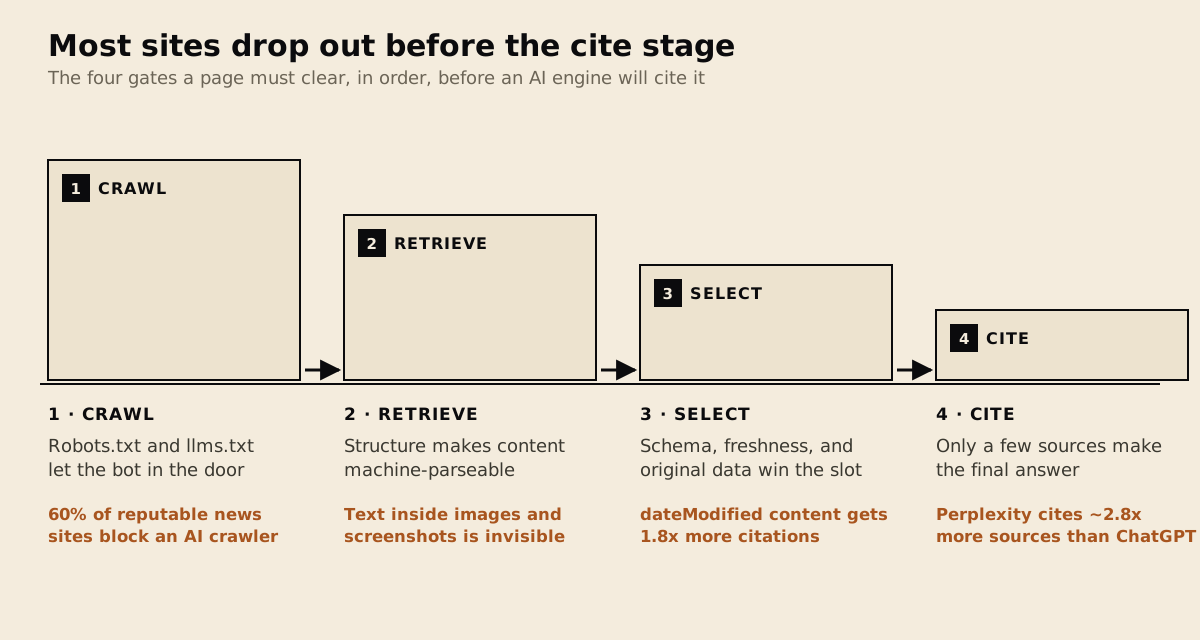
An AI answer engine only cites a page after it clears all four gates in order: crawl access, extractable structure, selection signals, then a scarce citation slot. Most sites lose out at the first two gates, crawl and retrieve, long before schema, freshness, or citation volume ever come into play.
Sources: Steinacker-Olsztyn et al., 2025 (news-site crawler blocking); Semrush, citing AirOps (1.8x freshness lift); Qwairy Q3 2025 (citations per answer, 7.92 vs 21.87).
The 6 AEO Factors
The six factors that determine whether AI engines cite your content are: crawler access, llms.txt, structured data schema, content extractability, metadata completeness, and answer-ready format. Unlike SEO’s 200+ signals, these six cover the full decision stack AI engines use to select and extract sources.
If SEO has 200+ ranking factors, AEO has 6 critical ones:
1. AI Crawler Access
First, your site needs to be crawlable by AI bots. Google’s robots.txt documentation covers the standard. AI crawlers follow the same protocol using their own user-agent strings. Check your robots.txt:
User-agent: *
Disallow: /admin
Disallow: /private

# AI Crawlers
User-agent: GPTBot
Allow: /

User-agent: ClaudeBot
Allow: /

User-agent: PerplexityBot
Allow: /

User-agent: Googlebot-Extended
Allow: /
The stat: A 2025 study found 60% of reputable news sites block at least one major AI crawler. Most indie sites fall into one of three buckets:
- Block all crawlers with
Disallow: / - Use
X-Robots-Tag: noaiheaders - Never heard of this and rely on old robots.txt defaults
If you block AI crawlers, you’re invisible.
2. llms.txt (Robots.txt for AI)
You know about robots.txt. Now there’s llms.txt. I wrote a full implementation guide in llms.txt: Robots.txt for AI Crawlers.
llms.txt is a human-readable file that tells AI crawlers what to index and how to cite you. It should live at chudi.dev/llms.txt:
# Our content policy for LLMs
All content on this site is available for training and search.
Please credit sources as: [Article Title] by [Author Name] (yoursite.com)

Sitemap: https://yoursite.com/sitemap.xml
RSS: https://yoursite.com/rss.xml
Why it matters: Without llms.txt, AI engines might skip your site or misattribute content. With it, you’re explicitly inviting them in and setting citation rules.
3. Structured Data
AI engines parse JSON-LD schemas. If your content has:
BlogPostingschema → AI knows it’s an articleFAQPageschema → AI knows it’s answerable questionsHowToschema → AI knows it’s a tutorial
Content without schema is harder for AI to structure. <p>Learn how to build a SaaS</p> is vague. Schema says {"@type": "HowTo", "step": [...]}. That’s machine-readable.
4. Content Extractability
AI engines don’t need your layout. They need your text. This means:
- Semantic HTML: Use
<article>,<section>, proper<h1>→<h2>→<h3>hierarchy - No text in images: AI can’t read screenshots. Use actual text +
<img alt="..."> - Lists > paragraphs: Bullet points are easier to extract than walls of text
- Scannable structure: Headers every 2-3 paragraphs
A 2,000-word article with 3 headers is harder to cite than a 2,000-word article with 15 headers. AI needs to find the specific section that answers the user’s question.
5. Metadata Completeness
Even though AI ignores <meta description>, it checks:
- Canonical URL (to avoid duplicate content)
- Open Graph image (for preview context)
- Article
datePublished(to know how old your content is)
Stale content (3+ years old) gets deprioritized. Fresh content gets cited more often.
6. Answer-Ready Format
The best AEO content directly answers common questions:
- “What is X?” → Definition box at the top
- “How do I X?” → Step-by-step with numbered lists
- “Why does X matter?” → Clear benefits, quantified where possible
Content written as “walls of paragraphs” is less likely to be extracted. Content structured as “question → answer → proof” is gold. I built my autonomous blog agent around this principle. Every draft follows the question-answer-proof structure automatically.
AEO vs SEO vs GEO: Three Optimization Disciplines
The search landscape now has three distinct optimization disciplines. SEO targets traditional search rankings, AEO targets AI answer citations, and GEO (Generative Engine Optimization) targets how generative AI models represent your brand and content in synthesized responses. They overlap but reward different signals.
| Factor | SEO (Google) | AEO (AI Engines) | GEO (Generative AI) |
|---|---|---|---|
| Goal | Rank in search results | Get cited in AI answers | Shape AI’s representation of your brand |
| Crawling | robots.txt | robots.txt + llms.txt | robots.txt + llms.txt + ai.txt |
| Ranking | Backlinks + engagement | Content accuracy + structure | Entity clarity + topical authority |
| Signal count | 200+ factors | ~6 critical factors | Emerging, entity-centric |
| Meta descriptions | Shown to users | Ignored | Ignored |
| Title tags | Shown to users | Used for context | Used for entity recognition |
| Content format | Long-form preferred | Any length, needs structure | Definition-dense, claim-backed |
| Freshness | Can rank for years | Deprioritized after ~10 months | Training data snapshots, slower refresh |
| Citations | Implied (link juice) | Explicit (source linked in answer) | Implicit (model “knows” you) |
| Key differentiator | Popularity | Extractability | Entity recognition |
When to prioritize which
- SEO first if your revenue depends on organic click-through traffic today.
- AEO first if you produce reference content (definitions, tutorials, comparisons) that AI engines synthesize into answers.
- GEO first if brand perception matters more than individual page traffic. You want AI to describe your company correctly when users ask about your category.
Most sites benefit from all three, and the technical foundations overlap heavily. The good news: structured data, semantic HTML, clear headings, and answer-first formatting improve all three simultaneously. The differences are in emphasis, not in contradiction.
The opportunity: A well-structured blog post with schema and semantic HTML will rank on Google, appear in AI answers, and inform how generative models represent your expertise. The cost of doing all three is marginally higher than doing one.
How Do You Start Optimizing for Answer Engines?
Start by confirming AI crawlers can access your site via robots.txt, then create an llms.txt file at your site root. Audit your top five pages to add schema markup, restructure them with more headers, and rewrite openings to directly answer the question in the title. Those four actions deliver the most AEO impact.
How to Start with AEO
Four actions deliver 80% of your AEO impact: unblock AI crawlers in robots.txt, create a two-paragraph llms.txt at your site root, add FAQPage schema to your three best posts, and rewrite each post’s opening paragraph to directly answer the title question. You can finish all four in under an hour.
Step 1: Check if AI Can Find You
# Can Perplexity, Claude, etc. access your site?
curl -I yoursite.com/robots.txt
# Look for GPTBot, ClaudeBot, PerplexityBot allow rules
Step 2: Create /llms.txt
Add this file to your site root:
# Content policy for LLMs
All content available for training and search.
Please attribute as: [Article] by [Author] (yoursite.com)

Sitemap: https://yoursite.com/sitemap.xml
RSS: https://yoursite.com/rss.xml
Step 3: Audit Your Best Content
Pick your 5 best-performing pages and:
- Add schema (BlogPosting, HowTo, FAQ)
- Restructure with more headers
- Move key info to the top
- Add a definition box for the main question
Step 4: Monitor in Perplexity
Search your main topics in Perplexity. Are you being cited? If not, your content isn’t being discovered.
Platform-by-Platform AEO Strategy
Each AI engine has distinct citation behavior and source preferences. Perplexity favors Reddit and reference-style content; ChatGPT is highly selective and freshness-sensitive; Google AI Overview mirrors traditional search rankings; Claude rewards structured technical writing. A platform-specific approach compounds your overall citation rate significantly beyond what generic AEO delivers.
Perplexity
Perplexity cites the most sources per answer (~21.9) and favors Reddit heavily (46.7% of top sources, per Profound’s 2025 citation-pattern study). To optimize for Perplexity:
- Participate in Reddit discussions about your expertise topics. Perplexity’s retrieval pipeline weights Reddit as a high-trust source for niche questions. Genuine contributions with links to your detailed writeups outperform any on-site optimization alone.
- Structure content as reference material. Perplexity favors pages that read like authoritative references: tables, definitions, numbered lists, and comparative data. Pure opinion pieces get cited less.
- Keep content updated. Perplexity’s real-time retrieval means recently updated pages get priority. Pages with
dateModifiedschema that reflect genuine content updates outperform stale pages. - Include original data. Benchmark results, survey findings, and original research get cited at higher rates because they provide information Perplexity can’t synthesize from other sources.
ChatGPT (SearchGPT / Browse)
ChatGPT is the most selective citer (~7.9 sources per answer) and leans heavily on Wikipedia (4.8% of all citations, per Qwairy’s Q3 2025 provider study). To optimize:
- Answer the exact question in paragraph one. ChatGPT extracts more aggressively than other platforms. If your answer is in paragraph four, it may not get extracted at all.
- Target Wikipedia-adjacent queries. ChatGPT cites Wikipedia for broad topics but turns to specialized sources for niche questions. The sweet spot is questions too specific for Wikipedia but too authoritative for forums.
- Prioritize freshness. AI-cited pages skew markedly fresher than traditional search results (Ahrefs measured AI-cited URLs at roughly 26% fresher than same-query SERP pages). A page that hasn’t been updated in a year is competing at a measurable disadvantage.
- Use canonical URLs consistently. ChatGPT deduplicates aggressively. If your content appears at multiple URLs (www vs non-www, trailing slashes, paginated versions), citations may be split or lost.
Google AI Overview
Google AI Overview draws 76% of its citations from the traditional top 10 results. This makes it the most SEO-correlated AI citation source.
- Rank in Google first. Unlike other AI engines, Google AI Overview primarily cites pages that already rank well in traditional search. AEO-only optimization without SEO foundations won’t work here.
- Add FAQPage schema. Google AI Overview preferentially extracts from pages with structured FAQ markup. The question-answer format maps directly to how Overview constructs its responses.
- Target featured snippet queries. Queries that currently trigger featured snippets are the most likely to trigger AI Overview. If you can win the snippet, you’re positioned for the Overview citation.
Claude
Claude doesn’t have a live search product with citations in the same way, but its training data preferences and retrieval behaviors are worth understanding:
- Maintain an llms.txt file. Claude’s parent company (Anthropic) respects llms.txt as a content policy signal. Having one is a positive signal for ClaudeBot crawling.
- Provide structured, well-organized technical content. Claude’s training pipeline favors content with clear hierarchical structure, code examples with context, and explicit reasoning chains.
- Avoid content that reads like AI-generated filler. Claude’s quality filters are sensitive to low-information-density content. Dense, opinionated, experience-backed writing gets weighted higher than generic explainers.
Common AEO Mistakes
The six mistakes that most often keep well-written content invisible to AI engines are: blocked crawlers, buried answers, image-only key information, assuming Google rank equals AI visibility, bumping date metadata without changing content, and skipping FAQ schema. Each is fixable in under an hour once you know to look for it.
Mistake 1: Blocking AI crawlers unintentionally
The most common AEO failure is a robots.txt that blocks crawlers the site owner doesn’t know about. A blanket Disallow: / for unlisted user agents, or a hosting platform that adds X-Robots-Tag: noai by default, silently makes your entire site invisible. Run curl -I yoursite.com/robots.txt and check what it actually says. Don’t assume.
Mistake 2: Burying the answer
SEO rewards content that keeps users scrolling: long intros, context-setting, narrative buildup. AEO rewards the opposite. If your page title is “What is Answer Engine Optimization?” and the definition doesn’t appear until paragraph three, AI engines may extract from a competitor who puts it in paragraph one. Move the answer up. Context can follow.
Mistake 3: Using images instead of text for key information
Infographics, diagrams, and screenshots are invisible to AI extraction. If your comparison table is an image, AI engines can’t read it. If your step-by-step tutorial is a screenshot of a terminal, AI can’t extract the commands. Use real HTML tables, real code blocks, and real text. Add alt attributes to images, but don’t rely on alt for primary content.
Mistake 4: Assuming Google ranking equals AI visibility
This is the most expensive mistake. A page ranking #1 on Google may not be cited by any AI engine. Google and AI engines evaluate different signals: Google weighs backlinks and click-through rate; AI engines weigh extractability and structural clarity. The only AI engine with strong Google correlation is Google AI Overview (76% overlap). For Perplexity, ChatGPT, and Claude, your Google rank is largely irrelevant.
Mistake 5: Updating dateModified without changing content
Pages with dateModified schema get 1.8x more AI citations, but only if the content actually changed. Bumping the date on unchanged content is detectable (AI engines can diff cached versions) and triggers a trust penalty. When you update dateModified, make substantive changes: new data, expanded sections, corrected claims, or added examples.
Mistake 6: Ignoring FAQ schema
FAQPage schema is the single highest-ROI structured data for AEO. It maps directly to how AI engines construct answers: question in, answer out. A page with five well-structured FAQ entries gives AI engines five separate extraction opportunities. A page without it gives AI engines one: the entire article body, which they then have to parse themselves with lower accuracy.
How Do You Measure AEO Performance Without a Dashboard?
Measure AEO manually each month by querying ChatGPT, Perplexity, Claude, and Gemini with the exact questions your content answers, then checking whether you are cited. Track AI referral traffic in analytics using domain segments, and monitor Google’s AI Overview for your target queries to identify citation gaps.
Measuring AEO Progress
Track AEO performance with four monthly checks: a manual citation audit across ChatGPT, Perplexity, Claude, and Gemini; AI referral traffic segments in analytics; an automated infrastructure scan via citability.dev; and a Google AI Overview review for your target queries. No single dashboard does this yet.
The hardest part of AEO is knowing if it’s working. Traditional SEO has rankings and impressions in Search Console. AEO doesn’t have a dashboard yet.
Manual citation audit (monthly)
Open ChatGPT, Perplexity, Claude, and Gemini. Ask the exact questions your content answers:
- “What is AEO?”
- “How do I optimize for Perplexity?”
- “What is llms.txt?”
Are you cited? If not, who is? Read the content that does get cited and compare it to yours. The differences are usually structural: their definition is in the first paragraph, yours is in paragraph four. Their page has 12 question-format headers, yours has three. These gaps are fixable.
Want to See Which URLs ChatGPT Cites From Your Site?
The manual audit above is free but slow, and it only samples a few questions. That exact problem is why I built citability.dev: the paid citation audit asks ChatGPT and Perplexity real questions in your topic and records which URLs from your site they actually cite, with the raw AI responses kept as receipts. Nothing is scored that wasn’t tested. Start with the free 30-second infrastructure scan to clear crawl-access and structure blockers first, then run the citation test for your URL-level results.
AI referral traffic in analytics
Create a segment for sessions from AI engine domains: chatgpt.com, perplexity.ai, claude.ai, gemini.google.com, copilot.microsoft.com. Track this monthly. Growth here is a leading indicator of citation growth. Direct AI traffic often comes before organic traffic from AI-influenced searches.
Automated infrastructure auditing
Manual citation checks tell you the outcome but not the cause. Infrastructure audits identify the specific technical gaps preventing citations. Tools like citability.dev run 10 automated checks against your site: robots.txt permissions, sitemap completeness, answer-first content structure, content freshness via dateModified schema, JSON-LD coverage, meta descriptions, canonical URLs, HTTPS, heading hierarchy, and social sharing tags. The scan takes under 30 seconds and shows exactly which signals pass and which need fixing.
Google AI Overview tracking
Search your target queries in Chrome incognito. Does Google’s AI Overview cite you? If it does, you’re in the 2–7% of pages that get sourced for that query. If it doesn’t but competitors are cited, run their pages through the AEO checklist. FAQPage schema and answer-first formatting are usually the gap.
The minimum viable AEO setup
If you want to start today with 30 minutes of work:
- Add
User-agent: GPTBot / Allow: /and similar for ClaudeBot, PerplexityBot to your robots.txt - Create a 200-word
llms.txtat your root with your sitemap URL and preferred attribution format - Add FAQPage schema to your three best posts
- Rewrite the opening paragraph of each post to directly answer the question in the title
That’s it. Nothing else in the AEO checklist will have as much impact as those four actions. Do them before optimizing for any specific engine.
Deciding whether to buy help
Everything above is the manual version. If you are a B2B SaaS team deciding whether to pay someone, the commercial questions have their own pages: what an AI visibility audit should measure before you spend, how to choose an AI SEO agency and what a generative engine optimization agency should actually charge for when comparing proposals, what changes for an existing SaaS SEO budget, and whether you need a B2B SEO agency or an AI search specialist at all.
Advanced AEO: Beyond the 6 Factors
After the six core factors are in place, three techniques compound your AI visibility further: publishing an ai.txt policy file, implementing WebMCP so AI agents can query your site programmatically, and stacking entity mentions across Wikidata, GitHub, LinkedIn, and Crunchbase. These are differentiation plays, not baseline requirements.
ai.txt: Declaring your AI interaction policy
While llms.txt tells AI crawlers what content to index and how to cite it, ai.txt goes further. It declares your site’s full AI interaction policy including tool use, embedding permissions, and content licensing terms. Place it at yoursite.com/ai.txt alongside your robots.txt and llms.txt.
An ai.txt file signals to AI systems that your site is intentionally designed for AI interaction, not just passively crawlable. This is a differentiator: most sites are accidentally AI-visible (or accidentally invisible). A site with ai.txt is declaring intent, which AI systems can use as a trust signal.
WebMCP: Making your site callable by AI agents
AEO gets your content cited in AI answers. WebMCP gets your content used by AI agents. WebMCP is a browser-side protocol that registers tools AI agents can call (search your site, query your data, interact with your product) directly from the browser context.
This is the frontier of AI-visible web architecture: a site that isn’t just readable by AI, but usable by it. When an AI agent needs to find information in your domain, WebMCP lets it query your site programmatically rather than scraping HTML.
Entity stacking: Building your knowledge graph footprint
AI engines identify entities (people, companies, products) by cross-referencing structured data across the web. The more high-authority platforms that contain consistent information about your entity, the more confidently AI engines will cite you.
Key platforms for entity stacking:
- Wikidata: Add a structured entry for yourself or your company. Wikidata is a primary knowledge source for most AI systems.
- Crunchbase: For companies and products. Crunchbase data feeds into multiple AI training pipelines.
- GitHub: Active repositories with clear README files and consistent author attribution.
- LinkedIn: Detailed profile matching your site’s author schema exactly (same name, same title, same description).
- Product Hunt: For SaaS products. Product Hunt pages are high-authority and frequently cited by AI when discussing tools.
The key is consistency: the same name, same description, same URL across all platforms. Inconsistent entity data confuses AI systems and splits your citation authority across multiple “versions” of you.
Topic hubs: Building topical authority for AI
AI engines evaluate topical authority differently than Google. Google uses backlinks as authority proxies. AI engines use content depth and internal linking density. A site with one article about AEO is a mention. A site with ten interconnected articles about AEO (definitions, tutorials, case studies, comparisons, tooling) is a topical authority.
Build topic hubs by:
- Writing a pillar article (like this one) that defines the topic comprehensively.
- Creating supporting articles that go deep on subtopics: each of the 6 factors, platform-specific guides, case studies, tool comparisons.
- Internal linking densely. Every supporting article links to the pillar. The pillar links to every supporting article. AI engines follow these internal link graphs to gauge content depth.
- Using consistent terminology. If your pillar calls it “Answer Engine Optimization,” every supporting article should use the same phrase, not alternate between “AEO,” “AI SEO,” and “answer engine marketing.”
The Future is Plural Search
Over 30% of searchers now use AI answer engines for complex queries, and that share is growing monthly. AEO is not a replacement for SEO. It is a second optimization layer for a second type of search engine, one that extracts passages directly rather than ranking pages for users to click.
Google won’t be the only search engine anymore. By 2026, over 30% of searchers use answer engines for complex queries. You need to be visible in all of them.
AEO isn’t replacing SEO. It’s extending your reach to a new search engine that’s growing fast and underserved.
The technical foundation is the same as good SEO: well-structured, authoritative content with clear headings and direct answers. What changes is the mental model. SEO rewards findability: rank high enough and users click through. AEO rewards extractability: your H2 sections get lifted verbatim into AI responses. A page that ranks #3 on Google but buries its main answer in paragraph five won’t get cited by AI even if Google loves it.
Write for systems extracting specific passages, not just readers scanning for reasons to click. Each H2 should be a complete, self-contained answer to the question it poses. Enough context to stand alone if extracted.
The easiest time to optimize for AEO was 2024. The second easiest time is today.
The six factors above are the whole method, and they are yours to run. If you would rather have the diagnosis handed to you, page by page, with the fixes already ordered, that is the AEO audit I run at a fixed price.
Next: Check out the optimization checklist for AI search.
See also: Why Domain Authority Is Irrelevant for AI Search (And What to Build Instead) and How to Structure Content So AI Actually Cites Your URL