
AI search engines do not rank pages. They score entities, then quote the entity that best matches the query. For a sub-DR-20 brand, this is the good news. You cannot outspend enterprise SEO teams on backlinks. You can out-engineer them on entity coherence. The broader AEO framework this entity-optimization fits inside is Answer Engine Optimization Explained.
This post is the engineering playbook for that work. It covers the three schemas that anchor the graph, the sameAs surface where most brands leak trust, the knowsAbout field that tells engines what you are an authority on, and the measurement loop that tells you when it is working. The reference model throughout is chudi.dev (the Person brand) and citability.dev (the product brand): a deliberate two-node graph that synergizes without cannibalizing.
§1, Why AI citations resolve to entities, not URLs
Classical SEO optimized for pages. Answer engines optimize for the entity behind the page. If two sites say the same thing and one site has a coherent Person + Organization + sameAs graph, the engine quotes the coherent site even when the other page ranks higher in traditional SERPs. Cite the entity, not the URL. That is the mental model shift this cluster pivots on. Coherence decides between pages that say the same thing. A page that says something new earns its quote another way, which originality signals and citation patterns explains.
§2, The three anchor schemas
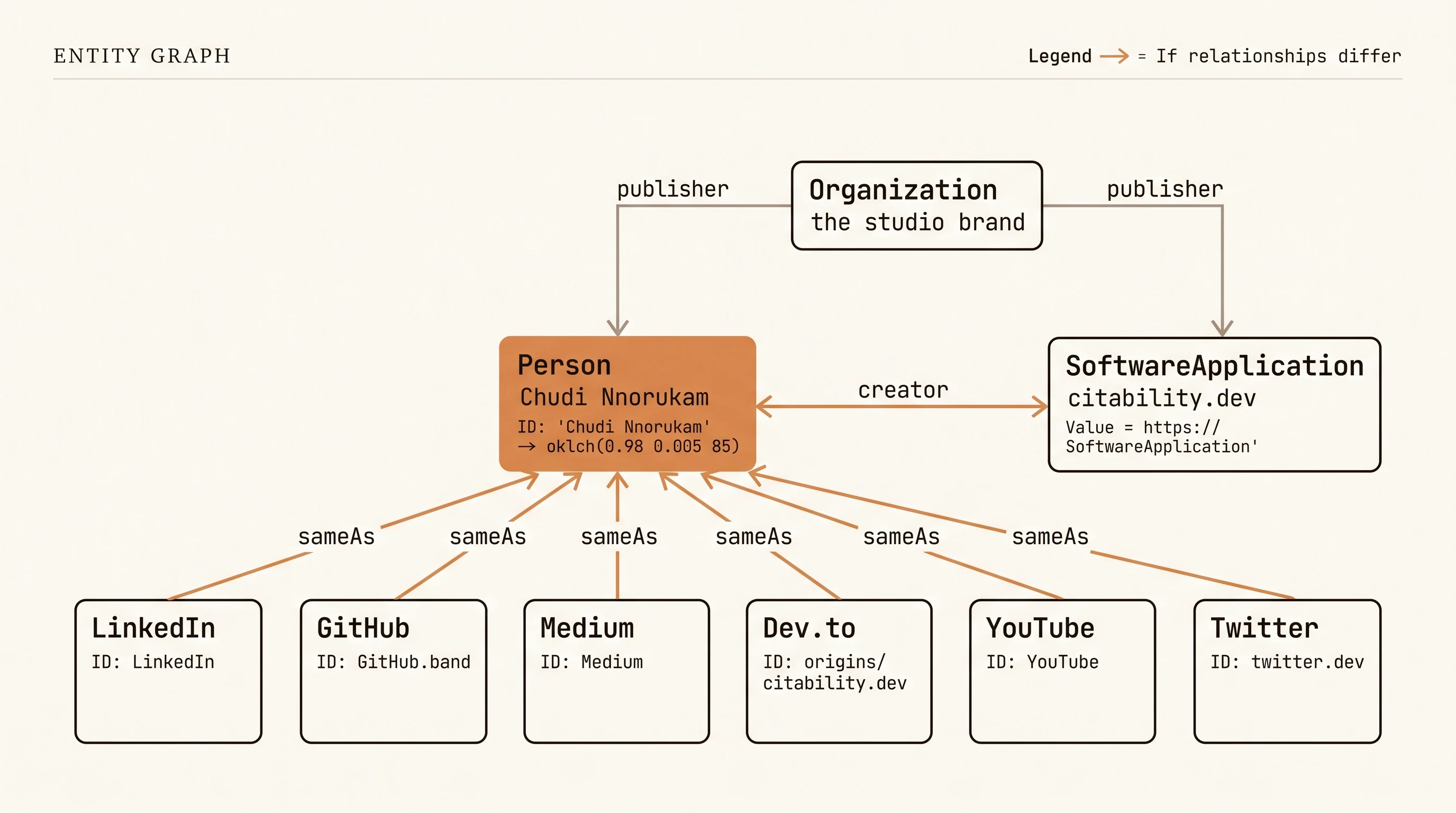
Every resilient entity graph has three anchor schemas. Person. Organization. SoftwareApplication. They cross-reference through creator, publisher, and about fields. Miss one anchor and the graph reads as a disconnected individual, a disconnected company, or a disconnected tool. Engines pick the version of your story they find easiest to summarize, which may not be the version you want quoted.
§3, sameAs coherence across platforms
The sameAs array is the single most valuable field in the Person schema for sub-DR-20 brands. It is also the field most brands let drift. Six platforms. Six subtly different job titles. Six subtly different descriptions. Engines treat this as ambiguity and choose a canonical, usually the platform with the highest authority, not the one you care about.
§4, The knowsAbout surface nobody uses
knowsAbout is the declarative authority claim. Use it to stake your territory. For chudi.dev, the stake is AI Visibility Engineering, Generative Engine Optimization, Entity Graph Architecture, and Sub-DR-20 SEO. Four claims. Four phrases an engine can match against a query.
§5, The citation flow
When a query arrives, an AI engine runs a pipeline. Retrieve candidate entities. Score coherence. Gate. Cite. Optimizing for citation means shortening the distance between query and gate. That pipeline decides what an engine quotes. Letting an agent act on your site is a separate layer. For that layer, what WebMCP is covers the experimental browser interface.
§6, Measurement: how you know it is working
The answer engines that matter (Perplexity, ChatGPT with search, Google AI Overviews) do not expose rank. They expose citations. Measurement is a different instrument than Google Search Console. Track citation count per engine, quote length per citation, and coherence-check failures across your sameAs graph. Before tracking what engines cite, confirm the main AI crawlers can fetch your pages with the AEO audit tool. For where this measurement falls in a full program, the 90-day AI visibility roadmap places it after the entity graph and canonical pages are live.
Bridge, from thinking to measurement
This post describes the thinking. citability.dev is the instrumentation. Run the citability scorer on any chudi.dev post to see what the engine actually extracts, which entity it resolves to, and where the coherence gates are failing.
Coherence failures are rarely one broken field. If the scorer comes back with a sameAs graph that disagrees with itself in four places, correct the whole graph in one pass. Then run the free AEO audit on the same domain as a separate check. It tests whether robots.txt lets the main AI crawlers in and whether your pages have a structure for extraction.