Perplexity Citation Format vs ChatGPT: How Each Engine Picks Sources
Perplexity quotes liberally. ChatGPT quotes selectively. The engine-level differences in citation behavior that change what a sub-DR-20 brand should optimize for, engine by engine.
Why this matters
Perplexity and ChatGPT treat citations differently. Perplexity is quote-dense and source-diverse. ChatGPT is quote-sparse and authority-biased. Optimizing for both requires two different move sets.
In this cluster
Cluster context
This article sits inside AI Visibility Engineering.
Entity graphs, schema architecture, and citation mechanics for sub-DR-20 sites competing on AI citations, not SERP rank.
SEO optimizes for rank. Answer engines optimize for citation-worthiness. This cluster is the engineering playbook for the second game, sized for operators, not enterprise SEO teams.
How ChatGPT and Perplexity Decide Which Sources to Cite
How answer engines like ChatGPT and Perplexity decide which sources to cite: six measurable factors, 2026 platform data, and the fix for each one.
Entity Optimization for Brands in AI Search
Rank is a single-page game. Entity coherence is the compounding game. How sub-DR-20 brands engineer a Person + Organization graph that AI search engines actually cite.
Schema.org for Answer Engines, the 40 Properties That Matter
A tactical guide to the Schema.org properties answer engines actually read. Which fields move citation decisions, which are noise, and how sub-DR-20 operators compress a full JSON-LD graph into the forty that matter.
Perplexity and ChatGPT are not the same engine with different logos. They apply citation rules that are different enough to require different optimization moves for a sub-DR-20 brand. Treating them as interchangeable is the single most common mistake an operator makes when planning GEO work for the quarter. The broader AEO framework this engine-comparison fits inside is documented in Answer Engine Optimization Explained.
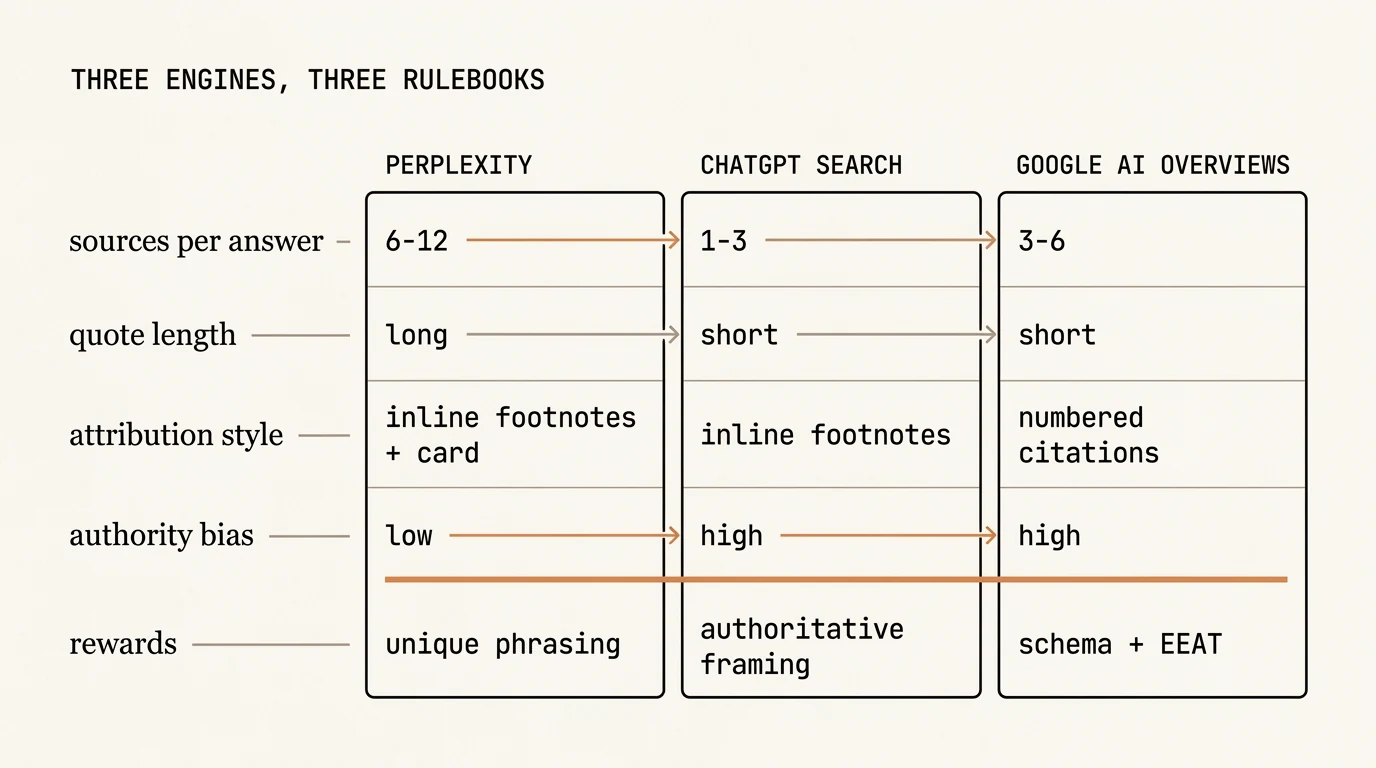
This post walks the engine-level differences. Where Perplexity rewards, ChatGPT does not. Where ChatGPT gates on authority, Perplexity gates on freshness and novel phrasing. Google AI Overviews sit in between, closer to ChatGPT in spirit but with a stronger schema requirement. A brand that optimizes only for one engine will see unbalanced citation mix. A brand that understands the differences can prioritize.
§1. How Does Citation Density Differ Between Perplexity and ChatGPT?
Perplexity shows six to twelve sources per answer in an inline card, and each citation is linked to a specific sentence or paragraph. ChatGPT with search shows one to three sources per answer, with footnote markers inside paraphrased prose. The density difference is not cosmetic. It is the product of two different retrieval pipelines: Perplexity retrieves many and cites many; ChatGPT retrieves many and cites few.
§2. What Does Perplexity Actually Read for Citations?
Perplexity’s citation scorer reads novel phrasing, source diversity, freshness inside thirty days, entity-graph matching, and concrete data points. Authority matters, but it is far from the heaviest weight. A well-written sub-DR-20 page with fresh, specific data outranks a DR-70 page with stale overview content. This is why Perplexity is the cheapest citation to earn for a small brand.
§3. What Does ChatGPT Actually Read When Selecting Sources?
ChatGPT’s selection layer biases toward domain authority, entity coherence, schema completeness, expert signals (author bio + credentials), and URL stability. Freshness matters less. Unique phrasing matters less. For a sub-DR-20 brand, this is the harder engine. The moves that win here are slower-compounding (schema, sameAs coherence, credentialing).
§4. Which Optimization Levers Map to Which Engine?
Seven levers, three engines, and different weights on each. Named concepts: heavy on Perplexity, medium on ChatGPT. Voice fingerprint: medium on Perplexity, low on ChatGPT. Freshness cadence: heavy on Perplexity, low on ChatGPT. Schema 40: medium on Perplexity, heavy on ChatGPT. Expert signals: low on Perplexity, heavy on ChatGPT. Original data: heavy on Perplexity, medium on ChatGPT.
§5. The prioritization rule for sub-DR-20
Start with Perplexity. The moves that win there (named concepts, freshness, original data, novel phrasing) are also the moves that compound into the brand moat over quarters. ChatGPT citations follow naturally as the entity graph matures and schema completes. Doing it in the opposite order means competing with DR-70 sites on their strongest field (authority) before owning the field where a smaller brand has structural advantage (freshness and specificity).
§6. Measurement, per-engine
One number is not enough. Track citation count on Perplexity, on ChatGPT with search, and on Google AI Overviews separately. The ratio between them is the diagnostic. A brand with 30 Perplexity citations and 2 ChatGPT citations is winning on freshness and losing on authority. Expected for a sub-DR-20 site, and the correct place to be for the first two quarters.
Bridge
citability.dev runs per-engine scoring and reports the mix separately. The mix itself is the strategy readout. Once you can see it, the next move is obvious.
The mix is visible in a minute. Deciding which two fixes to make first against your own pages is the slower part, and that is what the audit hands you, at a set price.
· Frequently asked
FAQ
How many sources does Perplexity cite compared to ChatGPT?
Perplexity cites 6 to 12 sources per answer via inline cards linked to specific sentences. ChatGPT with search cites 1 to 3 sources as footnotes inside paraphrased prose. The gap reflects two different pipelines: Perplexity retrieves many and cites many; ChatGPT retrieves many and cites few.
Why is Perplexity the cheapest AI citation for a sub-DR-20 brand to earn?
Perplexity gates on novel phrasing, freshness within 30 days, source diversity, and concrete data points, not domain authority. A well-written sub-DR-20 page with fresh, specific data outranks a DR-70 page with stale overview content, giving smaller brands a structural advantage they do not have on ChatGPT or Google AI Overviews.
What does ChatGPT prioritize when selecting citations?
ChatGPT's selection layer biases toward domain authority, entity coherence, schema completeness, expert signals such as author bio and credentials, and URL stability. Freshness and unique phrasing carry far less weight than on Perplexity. The moves that win here are slower-compounding: schema, sameAs coherence, and credentialing.
· Sources & further reading
Sources & Further Reading
Further reading
- Schema.org for Answer Engines, the 40 Properties That Matter /blog/schema-org-answer-engines-guide A tactical guide to the Schema.org properties answer engines actually read. Which fields move citation decisions, which are noise, and how sub-DR-20 operators compress a full JSON-LD graph into the forty that matter.
- Entity Optimization for Brands in AI Search /blog/entity-optimization-brands-ai-search Rank is a single-page game. Entity coherence is the compounding game. How sub-DR-20 brands engineer a Person + Organization graph that AI search engines actually cite.
- Content Intent Signaling: The robots.txt Directive That Controls How AI Uses Your Content /blog/content-intent-signaling-robots-txt robots.txt controls access. Content Intent Signaling controls usage. Three new directives separate training from citation permission.
- Entity-Level SEO vs Page-Level SEO: 8 AI Citations a Day After Switching /blog/entity-engineering-vs-page-seo Bing AI cited my site 8 times a day after I stopped tuning individual pages. The principle: entity-level SEO is the floor; page-level work is the ceiling.
- The 90-Day AI Visibility Roadmap I Run for Sub-DR-20 Sites /blog/building-ai-visibility-roadmap The 90-day AI visibility roadmap I run for sub-DR-20 sites: entity-graph baseline, five canonical pages, co-mention seeding, and a citation dashboard.
Reading Path
Continue the AI Visibility Engineering track
Previous
None
Next
None
Contextual next reads
How ChatGPT and Perplexity Decide Which Sources to Cite
How answer engines like ChatGPT and Perplexity decide which sources to cite: six measurable factors, 2026 platform data, and the fix for each one.
Entity Optimization for Brands in AI Search
Rank is a single-page game. Entity coherence is the compounding game. How sub-DR-20 brands engineer a Person + Organization graph that AI search engines actually cite.
Schema.org for Answer Engines, the 40 Properties That Matter
A tactical guide to the Schema.org properties answer engines actually read. Which fields move citation decisions, which are noise, and how sub-DR-20 operators compress a full JSON-LD graph into the forty that matter.
Want more of this in your Google results?
What do you think?
I post about this stuff on LinkedIn every day and the conversations there are great. If this post sparked a thought, I'd love to hear it.
Discuss on LinkedIn