
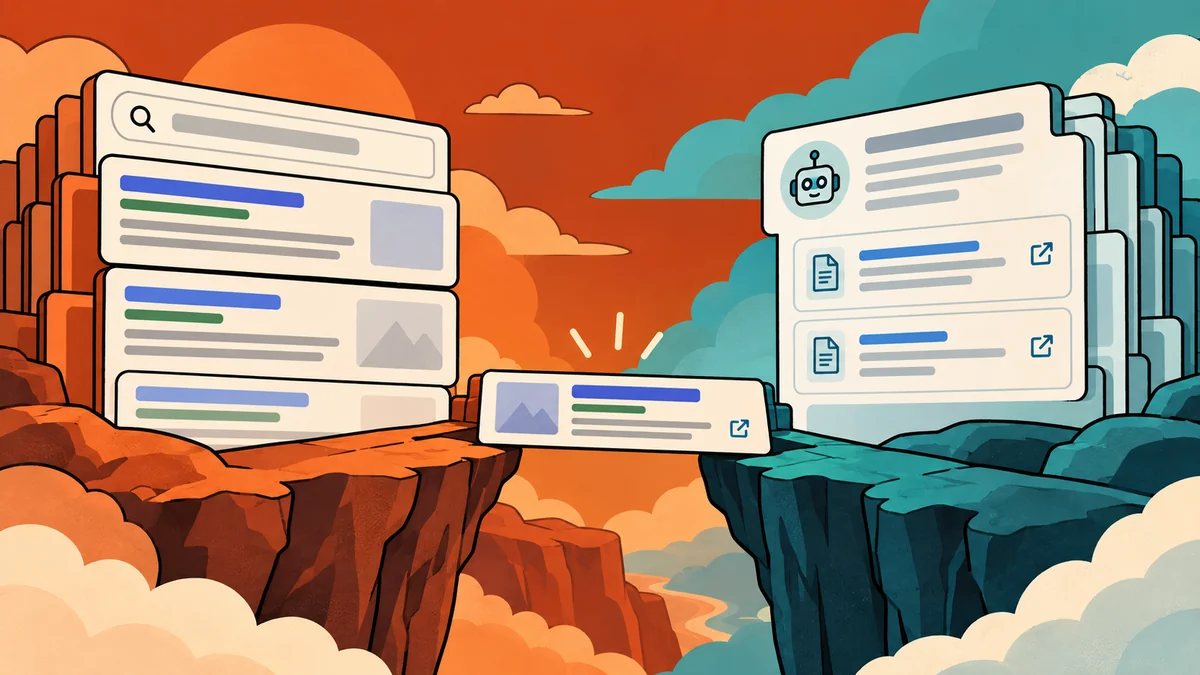
Your page can sit at rank one on Google and still be invisible inside the answer a person reads instead of the results list. Those two outcomes get talked about as if they move together. Nobody had actually lined them up side by side on the same questions, so I did it myself.
The short answer
I took ten buyer questions, pulled the top three organic Google results for each, then asked one AI answer engine the identical ten questions on the same day and wrote down every page it cited. Then I joined the two lists.
Out of thirty ranked pages, one page also showed up as a citation. Out of thirty ranked domains, two domains showed up somewhere in the citation list, though not always on the same document. Nine of the ten questions shared nothing between the two columns at all. And before a reader ever reached the ranked results, an AI-generated summary already sat above them on every single question.
This does not say ranking is worthless. It says that on this set, holding a top-three spot bought almost no presence inside the answer a buyer actually reads, and that claim gets repeated in this field far more often than it gets checked.
How the check worked
I wrote down ten questions a buyer would type, not brand names. Two examples: “Why is my company invisible to ChatGPT?” and “How does ChatGPT decide which part of a webpage to quote?” Every question came from a set written before this check existed, so nothing here was picked because it would produce a good result.
For each question I ran a live Google search and recorded the first three organic results, in the United States, in English, on desktop. Then, the same day, I asked one AI answer engine the same ten questions, once each, and recorded every URL the answer text itself cited. No retries, no cherry-picked run.
Citation check
1 in 30 ranked pages was also cited by the AI answer.
Example from the September 8, 2026 measurement: ten buyer questions, same day, one AI answer engine. The lit cell is question 4, result 2.
Then I joined the two columns on each question: how many of the three ranked pages also turned up in the citation list, first counted page by page, then counted domain by domain, because a domain match on a different page is a weaker result than it looks and the two numbers tell different stories.
The full table
| # | Buyer question | Top 3 on Google | Cited by the AI answer | Page overlap | Domain overlap |
|---|---|---|---|---|---|
| 1 | How does ChatGPT decide which part of a webpage to quote? | ziptie.dev, quora.com, searchscore.io | almcorp.com, deepsmith.ai, getmorphic.com, help.openai.com, searchengineland.com, serp-secrets.com, stridec.com | 0 of 3 | 0 of 3 |
| 2 | Why does AI quote one section of a page and not another? | reddit.com, intelitune.com, get3rd.com | anthropic.com, arxiv.org, blog.google, developers.google.com, researchgate.net, seroundtable.com | 0 of 3 | 0 of 3 |
| 3 | How do I get AI to quote my page instead of a competitor’s? | reddit.com, facebook.com, effiqs.com | arxiv.org, attrifast.com, frase.io, neptuneweb.com, surferseo.com | 0 of 3 | 0 of 3 |
| 4 | What makes a section of a page citable by an LLM? | reddit.com, kime.ai, arxiv.org | arxiv.org, kime.ai, kopp-online-marketing.com, machinerelations.ai | 1 of 3 | 2 of 3 |
| 5 | Does AI search match exact keywords or meaning when picking sources? | databricks.com, help.knowledge-architecture.com, quora.com | anthropic.com, blog.google, developers.google.com, infoq.com, ipullrank.com, redis.io, unstructured.io | 0 of 3 | 0 of 3 |
| 6 | Why does ChatGPT recommend my competitor instead of my business? | reddit.com, trustsignals.com, linkedin.com | thedigitalbloom.com | 0 of 3 | 0 of 3 |
| 7 | My site ranks first on Google but AI never mentions it, why? | reddit.com, youtube.com, quora.com | adamarant.com, ahrefs.com, discoveredlabs.com, getpassionfruit.com, prismic.io, technologychecker.io, yourdomain.com, ziptie.dev | 0 of 3 | 0 of 3 |
| 8 | How do I find out which competitors AI recommends over me? | frictionai.co, orbitmedia.com, youtube.com | builtin.com, business.adobe.com, frase.io, slatehq.com, tryprofound.com, usegrowthos.com, useomnia.com, visiblie.com | 0 of 3 | 0 of 3 |
| 9 | Why is my company invisible to ChatGPT? | reddit.com, entrepreneur.com, advertisingissimple.com | cloro.dev, crawlercheck.com, enilon.com, learn.g2.com, marceldigital.com, pravinkumar.co, prnewswire.com, semrush.com, seroundtable.com, understoryagency.com, xseek.io, yourdomain.com | 0 of 3 | 0 of 3 |
| 10 | How do I get ChatGPT to recommend my business? | reddit.com, entrepreneur.com, community.openai.com | contently.com, developers.openai.com, help.openai.com, lyv-ia.com, position.digital, semrush.com, surfacelocal.com, wsiworld.com, ziptie.dev | 0 of 3 | 0 of 3 |
Question 7 is the reader’s own version of this problem, worded almost exactly as a person would type it: your site ranks first, and the AI answer never mentions it. Google ranked a Reddit thread, a YouTube video, and a Quora thread for that question. The AI answer cited eight other domains, none of them matching. It also cited a page at the literal address yourdomain.com, a placeholder written inside the answer’s own prose rather than a real business. I counted it because the extraction rule counts every URL the answer text contains, and that choice can only push the overlap number down, never up.
The one exception
Question 4 is the single case where a page matched. Google’s top three for “What makes a section of a page citable by an LLM?” included kime.ai and an arxiv.org paper. The AI answer cited kime.ai directly, and separately cited arxiv.org, though a different paper than the one ranking third. That is the honest reading behind the domain-level number: two domains overlapped, but only one specific page did. A domain matching is not the same claim as a page matching, and treating them as the same claim would have inflated the result.
What the AI Overview did on every question
Before either list even mattered, an AI-generated summary already occupied the top position on all ten questions. Not nine, not most. Ten of ten. A reader typing any of these ten questions saw a generated answer before seeing a single organic result, ranked or not. Ranking first among the organic results still means ranking second on the page, behind an answer nobody wrote to be found there.
Why this matters more than another “why AI does not cite you” post
Plenty of writing, including some of mine, has measured how often AI answer engines mention a brand at all. That is a real question, and it has a real answer, but it treats the two systems as separate topics. This check does something narrower and more useful: it takes the same ten questions and asks whether the page that already earned a top ranking gets any credit at all inside the citation. On this set, it mostly does not. Ranking and being cited are not the same reward for the same work. They are two different systems reading two different signals, built from overlapping but distinct source pools, and a strategy built to win one does not automatically win the other.
Run this on your own pages
Search the question your buyer would actually type, not your brand name. Write down the top three organic results. Ask an AI assistant the identical words, the same day, and list every page it cites. Count how many of your three top results show up, at the page level and again at the domain level, because the two counts tell different stories. Do this across ten questions rather than one, because a single question tells you almost nothing about a pattern.
If you would rather not build the check by hand, citability.dev/scan runs this same comparison against your own domain: your ranked pages against what an AI answer actually cites for the same questions.
What this does not claim
The answer engine here was Claude run from its command line with web search turned on, asked once per question, and it issued between three and six live searches on every one. It is one engine, not ChatGPT and not Perplexity, and one run. AI answers are not stable from one run to the next, so this is a single sample rather than a measured rate. The ten questions were chosen by a fixed rule, the first five questions from each of two existing question sets, and not sampled at random from real search demand. The Google results are United States, English, desktop, and only the first page. URLs cited by the AI answer were pulled from the answer text by pattern matching, so a placeholder like yourdomain.com written inside a sentence counts as a citation the same as a real business page would. That choice can only understate the overlap, never overstate it. Overlap was counted only against the Google top three by design, so a page ranking fourth or fifth and still getting cited counts as zero overlap here, because the claim under test was specifically about the top three.
This does not prove ranking is worthless, and it does not prove the gap holds across every category or every AI engine. It shows one thing clearly: on this set of ten buyer questions, a top-three Google position bought almost no presence inside the answer a person actually reads, and the two outcomes deserve to be measured separately rather than assumed to move together.