
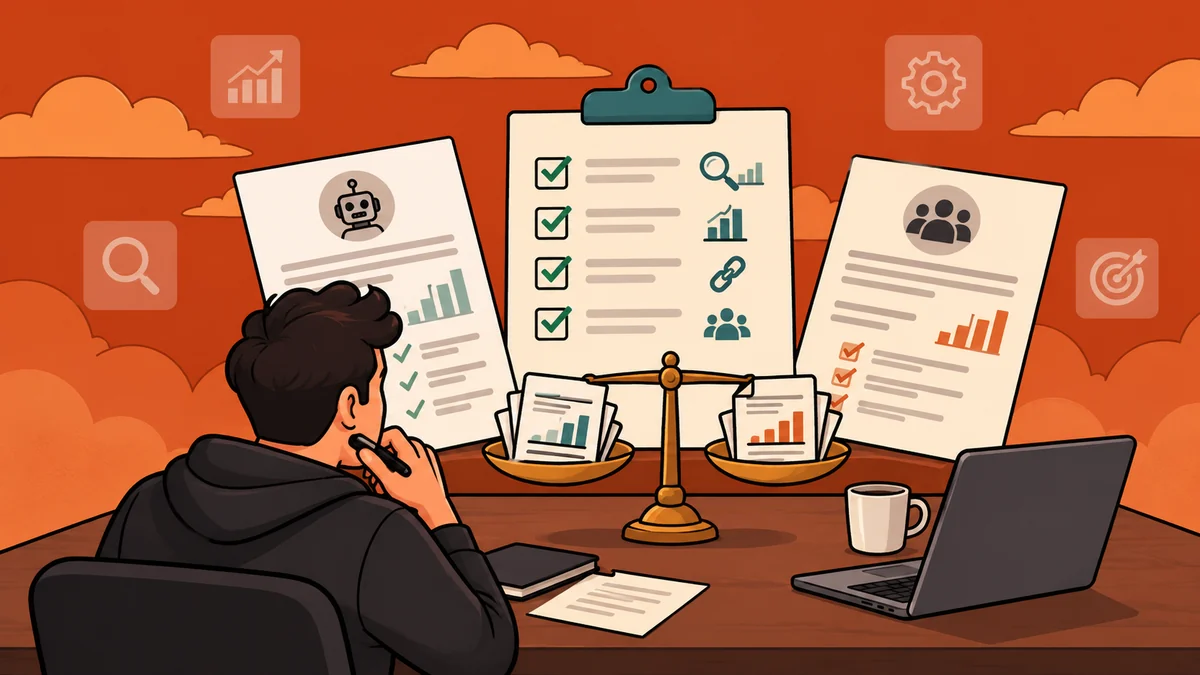
The best AI SEO agency for a B2B SaaS company is the one that can show you a dated baseline of what AI engines currently say about your category, explain how it will measure change against that baseline, and tell you plainly when the gap is not worth paying to close. You will not find that agency on a ranked list, because ranked lists of agencies are written by agencies. You find it by requiring evidence.
This page is the evaluation framework. It does not name a winner, and it does not rank me. It gives you the questions to ask, the deliverables to demand, the claims to distrust, and the situations where you should hire a traditional SEO agency instead. If you want the background on how AI engines pick their sources, start with the answer engine optimization explainer.
What “AI SEO” has to mean before you can buy it
The phrase covers three different jobs, and most vendors sell one while implying all three.
| Job | What it produces | Who genuinely needs it |
|---|---|---|
| Measurement | Who AI engines name for your buyer questions, per engine, with sources, dated | Anyone who has not measured yet, which is almost everyone |
| Diagnosis | Why your pages lose on specific questions, labelled by cause | Companies with a measured gap and a budget to close it |
| Remediation | Pages, schema, entity clarity, corroborating mentions, crawler access | Companies with a diagnosed cause worth fixing |
Ask which of the three a proposal covers. A monthly “AI visibility score” is measurement without diagnosis. A content package is remediation without measurement. Neither is wrong, but you should know which one you are paying for.
Evidence to require before signing
A baseline they ran themselves. Ask the agency to show its own numbers for its own category, including the ones that make it look absent. I publish mine: in 47 answers across three engines, my product was named 3 times, all on one engine. An agency that has never measured itself is guessing about you.
A method you could reproduce. Question list, engines, session hygiene, how brand names are matched, how often pulls are repeated. If the method is proprietary and unexplained, the number cannot be checked.
Per-engine reporting. ChatGPT, Perplexity and Google AI Overviews carry different vendor sets. The citability.dev panel I built reports them separately for that reason. A single blended score hides the finding that decides where to spend.
A stated noise floor. Citation presence moves between pulls. An agency that reports a two-point change as a win has not measured its own variance.
A written repair list before the retainer. The diagnosis should be a deliverable you can take to your own team. If it only exists inside a retainer, you are buying dependence.
What an engagement must measure
If a proposal does not include these four numbers, it cannot tell you whether it worked.
- Share of answer per engine on a fixed question set, dated.
- Named competitors per question, so you know who you are displacing.
- Cited sources per answer, so repairs target the pages engines actually read.
- Empty questions, where no vendor is named. In my study Perplexity named nobody in 9 of 16 buyer questions. Those are the cheapest wins and the easiest to miss.
Then the same four numbers again, same method, after the work. Anything else is a story.
Claims to distrust
- “Guaranteed citations” or “guaranteed AI rankings.” Nobody controls what an engine generates. A guarantee here is a guarantee the vendor has not measured variance.
- A single visibility score with no source list. You cannot act on a score.
- “AI-optimized content” as the whole offer. Content is one repair among several. Crawler access, entity clarity and third-party corroboration often matter more, and none of them is content.
- Case studies with no baseline date. A before number without a date and a method is an anecdote.
- Claims that Google rank no longer matters. It still matters. It is just not the same measurement. The SaaS SEO page covers what transfers and what does not.
When a traditional SEO agency is the better choice
This is the section most agency pages leave out, so read it twice.
Hire a traditional SEO agency when:
- Your site has unresolved technical debt: crawl errors, slow pages, duplicate URLs, thin templates. AI engines read the same pages Google does. Fix the house first.
- You have no content answering your category questions at all. AI discovery work has nothing to diagnose until pages exist.
- Your buyers find you through long-tail informational search and convert on the site. That is a rank-and-traffic problem, and rank-and-traffic agencies are good at it.
- Your budget is under a few thousand a month. Traditional SEO has a longer track record of compounding at that spend.
Hire an AI search specialist when:
- You rank well and traffic is stable, but sales calls mention a competitor “ChatGPT recommended”.
- You already have the pages and want to know why engines do not use them.
- You need a measured answer to “is this even a problem for us” before committing a content budget.
Hire both when the foundations are solid, a measured gap exists, and the repairs are large enough to need a content team. Have the specialist diagnose and the agency execute against the repair list.
How to compare two proposals
| Question | Good answer | Warning sign |
|---|---|---|
| What will you measure first? | A dated baseline on named buyer questions, per engine | “We will start creating content in week one” |
| How will we know it worked? | Same method, same questions, stated noise floor | Traffic, impressions or a proprietary score |
| What if there is no gap? | “Then we will tell you and you should spend elsewhere” | Silence, or a reframe toward a retainer |
| Who owns the diagnosis? | You do, in writing, before any retainer | It lives inside the platform |
| Have you measured yourselves? | Here are our numbers, including the bad ones | “Our clients see great results” |
Frequently asked questions
Should I just pick the agency with the best-looking ranked list? No. Ranked lists of AI SEO agencies are almost always written by one of the agencies on them, or by a directory paid by them. Use the evidence checklist above instead.
Is a freelancer or a small specialist worse than an agency? Not for measurement and diagnosis, which are one-person jobs done by hand. Agencies win on remediation volume, not on judgment.
What does a fair first engagement look like? A short, fixed-scope diagnostic with a written repair list, priced so that walking away is easy. Mine is described here, with the free review first so you see real answers before paying anything.