
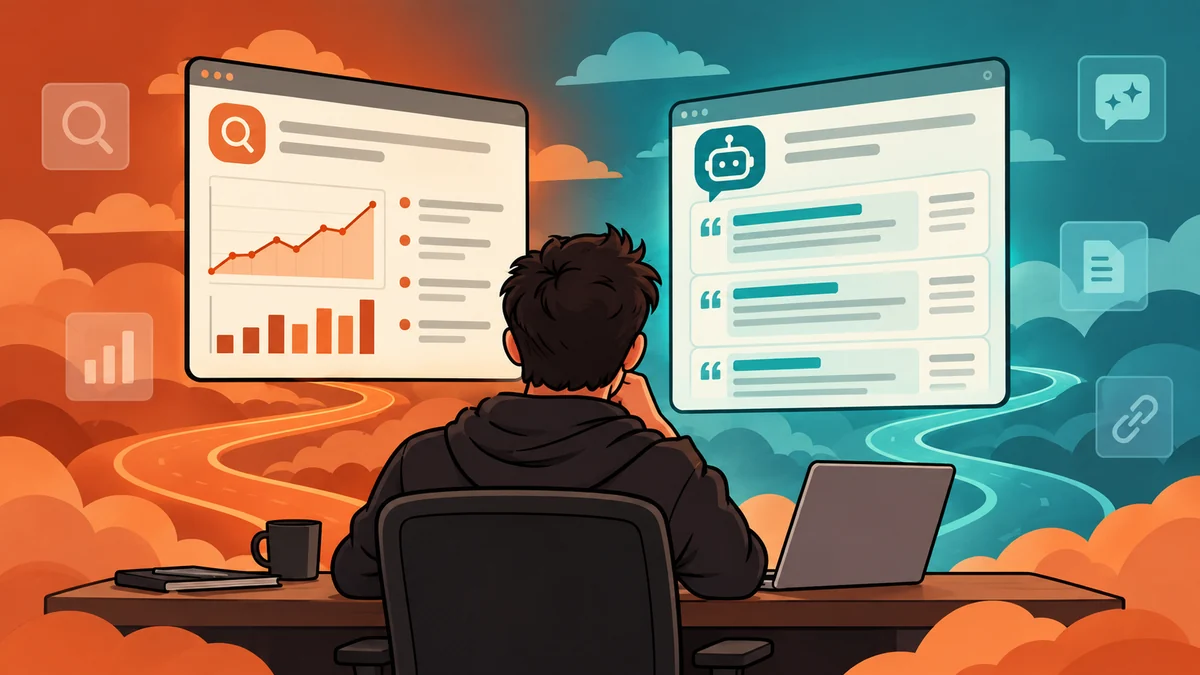
SEO for SaaS in the AI search era keeps almost everything a good SaaS SEO programme already does, and adds one measurement most programmes do not have: what ChatGPT, Perplexity and Google AI Overviews say when a buyer asks for a shortlist. Rank and traffic reports measure the page. AI answers are an outcome the page feeds into, and no rank report records who the answer named. That is the gap, and it is a reporting gap before it is a content gap.
This page is for teams that already spend on SaaS SEO and want to know what changes. It does not argue that traditional SEO is over. It is not. The mechanics of how AI engines choose sources are in the answer engine optimization explainer; this page is about what to keep, what to add, and what your current reports cannot tell you.
What transfers from traditional SaaS SEO
Most of it. AI engines read the same pages Google does, and they prefer pages that Google would also rank well.
| Foundation | Still matters? | Why |
|---|---|---|
| Crawlability and site speed | Yes | An engine that cannot fetch the page cannot cite it |
| Clear page-per-intent architecture | Yes | Engines quote passages; one question per page makes the passage findable |
| Comparison and alternatives pages | Yes, more than before | Buyer questions to assistants are mostly comparison questions |
| Backlinks as a trust signal | Partly | In a seven-site audit, domain authority did not predict citations; specific corroborating mentions did |
| Keyword research | Yes, reframed | Keywords become the buyer questions you ask the engines |
| Rank tracking | Yes, as one input | It measures the page, not the answer |
If your current agency does these well, keep them. Nothing on this page replaces them.
What is new: the answer is a different measurement
Three things change when a buyer asks an assistant instead of typing a keyword.
The engine names companies, not URLs. A buyer asking “which analytics tool suits a 40-person SaaS team” gets four company names and maybe two citations. Your rank on that keyword tells you nothing about whether you were one of the four.
Citations do not follow rank. In a study of eight commercial queries, 36 of 59 sources cited by Google AI Overviews were outside the organic top five. Ranking well helps, and it is not the same thing as being quoted.
Engines disagree. In my own 47-answer study, Perplexity named no vendor in 9 of 16 buyer questions, ChatGPT named none in 6 of 16, and Claude named none in 1 of 15. A single blended visibility score hides where the opportunity actually is.
What traditional reporting cannot answer
Put these questions to your current dashboard. If it cannot answer them, that is the gap, and it is not your agency’s fault. The tooling was built to measure pages.
- Which buyer questions does an assistant answer with a competitor, and never with us?
- Which of our pages, if any, do the engines cite, and for which questions?
- Which questions get no vendor at all? These empty answers are the cheapest wins in the category, and no keyword tool starts from them.
- Did last quarter’s content change any of the above? Traffic can rise while share of answer stays at zero.
Observation: your reports show rank and sessions. Inference: because those numbers are healthy, AI discovery is fine. That inference is untested until someone asks the engines.
How to add the measurement without replacing the programme
You do not need a second agency or a new platform to get a first read.
- Write fifteen to twenty buyer questions from sales calls and support tickets, phrased the way a buyer would ask an assistant.
- Ask each engine in a clean session and record every company and source named.
- Count per engine. Keep the question list fixed so next month is comparable. A spreadsheet works; I use the citability.dev panel for my own products because it keeps the raw answers as receipts.
- Hand the empty questions and near misses to your existing content team first. They are pages, and your SEO team already knows how to build pages.
The AI visibility audit page has the full method and how to read the result. If you would rather have the first read done for you, that is what the AI Discovery Review is: a sample of your buyer questions, who appears, which sources support them, and whether the gap is worth fixing.
When to leave your SEO programme alone
- Your organic pipeline is growing and sales never mentions an assistant. Measure once for a baseline and move on.
- You are still fixing crawl, speed or template problems. Those fixes help both measurements. Finish them.
- You have no comparison or alternatives pages. Build those first. They are the pages engines quote most, and they are ordinary SEO work.
- Your budget only covers one thing. Keep the foundations. AI discovery work on a weak site has nothing to diagnose.
Frequently asked questions
Should I fire my SaaS SEO agency and hire an AI search specialist? Almost never. Keep the agency for foundations and remediation. Add a measured baseline so both of you know whether there is a gap. The decision page covers when each is the right buy.
Do AI answers actually drive B2B SaaS pipeline? It depends on the category, and the honest answer is to check your own sales calls before spending. The measurement above costs an afternoon and tells you whether the question is worth asking.
Will good SEO automatically get me into AI answers? It helps and it is not sufficient. Rank and citation are related but measured differently, and only one of them shows up in your current report.