
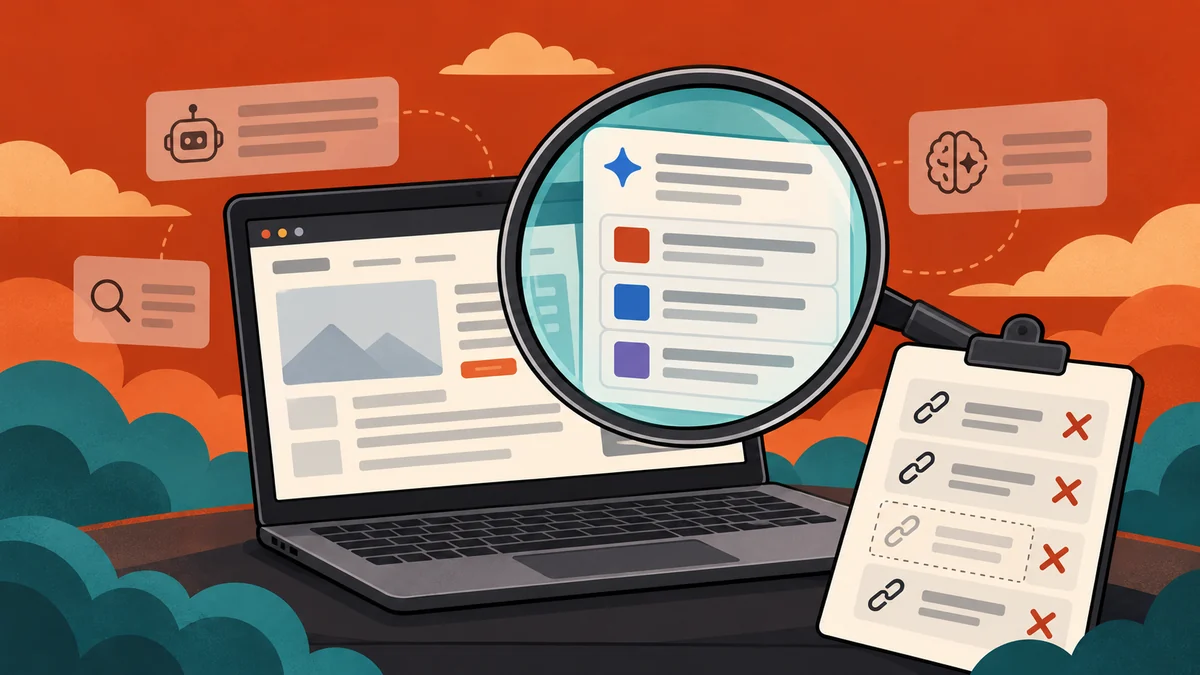
An AI visibility audit answers one commercial question: when a buyer in your category asks ChatGPT, Perplexity or Google for a shortlist, who gets named, and are you on it? A useful audit records the answers to a fixed set of buyer questions on each engine, names every company and source that appears, and tells you whether the gap is large enough to be worth money. A score without that source list is a dashboard, not an audit.
This page explains what to measure, how to read the result, and how to decide whether a gap is commercially meaningful. If you want the mechanics of how answer engines choose their sources first, the answer engine optimization explainer covers that; this page assumes you already suspect a competitor is winning and want to find out.
What an AI visibility audit measures
Observation, not opinion. The audit asks engines the questions your buyers ask and writes down what comes back. Four measurements matter:
| Measurement | What it answers | Why a rank report cannot give it |
|---|---|---|
| Share of answer, per engine | How often your company is named across the question set | Engines name brands, not URLs, and each engine carries a different vendor set |
| Named competitors | Which companies appear instead of you, and how often | No search tool tracks brand mentions inside a generated answer |
| Cited sources | Which pages the engine pulled from to support each answer | Citations come from outside the organic top five more often than not |
| Empty questions | Questions where no vendor was named at all | These are invisible to any tool that starts from a keyword |
The fourth row is the one buyers underestimate. In my own 47-answer study, Perplexity named no vendor in 9 of 16 buyer questions and ChatGPT named none in 6 of 16. An empty question is the cheapest gap to close, because there is no incumbent to displace, and nobody finds it without asking the engine directly.
How to run one yourself
You can run a credible first pass in an afternoon with no tooling.
- Write fifteen to twenty buyer questions. Not keywords. The sentence a buyer types the week they are ready to spend: “Which tools do X for a team of 40 on Y?” Include comparison questions and “is Z worth it” questions.
- Ask each engine in a clean session. No account history, no memory, no personalization. Record the full answer.
- Record every company named, including yours. Match brand names, not domains. Engines say a company name far more often than they print its URL.
- Record every cited source where the engine shows one.
- Count per engine. Do not average across engines. Perplexity and ChatGPT disagree so sharply that an average hides the finding.
The method is deliberately plain. The value comes from the fact that almost no company in your category has run it, so almost nobody knows their real number.
How to read the result
The count tells you the size of the gap. The source list tells you the cause. There are four causes, and they need different repairs.
| What you see | Likely cause | Smallest repair |
|---|---|---|
| Named nowhere, competitors named everywhere | Your pages are absent from the engine’s vendor set for the category | A page that answers the category question directly, plus a corroborating third-party mention |
| Named on one engine, absent on the others | Engines pull from different source pools | Find which sources the missing engines cite and get present there |
| Cited but not named | The engine used your page as evidence without treating you as a vendor | Entity clarity: the page must say what the company is and does in plain text |
| Nobody named | Empty question, no incumbent | The cheapest win. One good page can own the answer |
Label each row as observation, evidence or inference. “We appear 2 of 16 times on ChatGPT” is an observation. “Semrush appears 8 of 16 times and every answer cites their comparison page” is evidence. “We are absent because we have no comparison page” is an inference, and it should be tested with one page before anyone spends a quarter on it.
Is the gap commercially meaningful?
Not every gap is worth fixing. Ask three questions before spending anything.
Do your buyers actually ask assistants? In categories where buying is driven by outbound or by a procurement list, AI discovery may not touch the deal. Check whether your sales calls ever mention ChatGPT or Perplexity.
Are the questions you are absent from the ones that lead to a purchase? Absence from “what is X” matters less than absence from “which X vendor should a 50-person team use”.
Is there a plausible page that could win? If you have no content that could answer the question, the repair is a page, and you should price the page, not the audit.
If the answers are yes, yes and yes, the gap is worth measuring properly and then closing. If any answer is no, the honest recommendation is to spend elsewhere first. The decision page on B2B SEO agencies versus AI search specialists walks through those cases.
When an AI visibility audit is not the right move
- You have no organic programme at all. Fix crawlability, a basic page set and a working site first. An audit of an empty house reports emptiness.
- Your category has fewer than five buyer questions people ask an assistant. The sample is too small to measure. Wait, or measure adjacent categories.
- You already know you are absent and why. Skip the audit and build the page. Measure after.
- You want a guarantee of citations. Nobody can offer one truthfully. Citation presence changes between pulls. What an audit gives you is a dated baseline and a repeatable method.
What I use to run it
I run this measurement on my own products first and publish the numbers, including the bad ones. The citability.dev panel runs the retrieval pulls; the analysis and the repair list are done by hand, per question. The same method is what the AI Discovery Review delivers for a client: a buyer-question map, share of answer per engine, the cause labelled for each absence, and a repair list ordered smallest first.
Frequently asked questions
How many questions does an audit need? Fifteen to twenty for a first read. Fewer than ten and one odd answer moves the number too far. More than thirty and you are paying for precision the decision does not need.
How often should it be repeated? Monthly is enough for most B2B categories. Answers move between pulls, so treat any single read as a range rather than a point.
Does ranking well on Google mean I will appear in AI answers? No. In a study of eight commercial queries, 36 of 59 sources cited by Google AI Overviews were outside the organic top five. Rank and citation are related but not the same measurement.
Can I run it with a tool instead of by hand? Tools can run the pulls. The part that costs money to get wrong, deciding which absence to fix first, still needs a person reading the answers.