
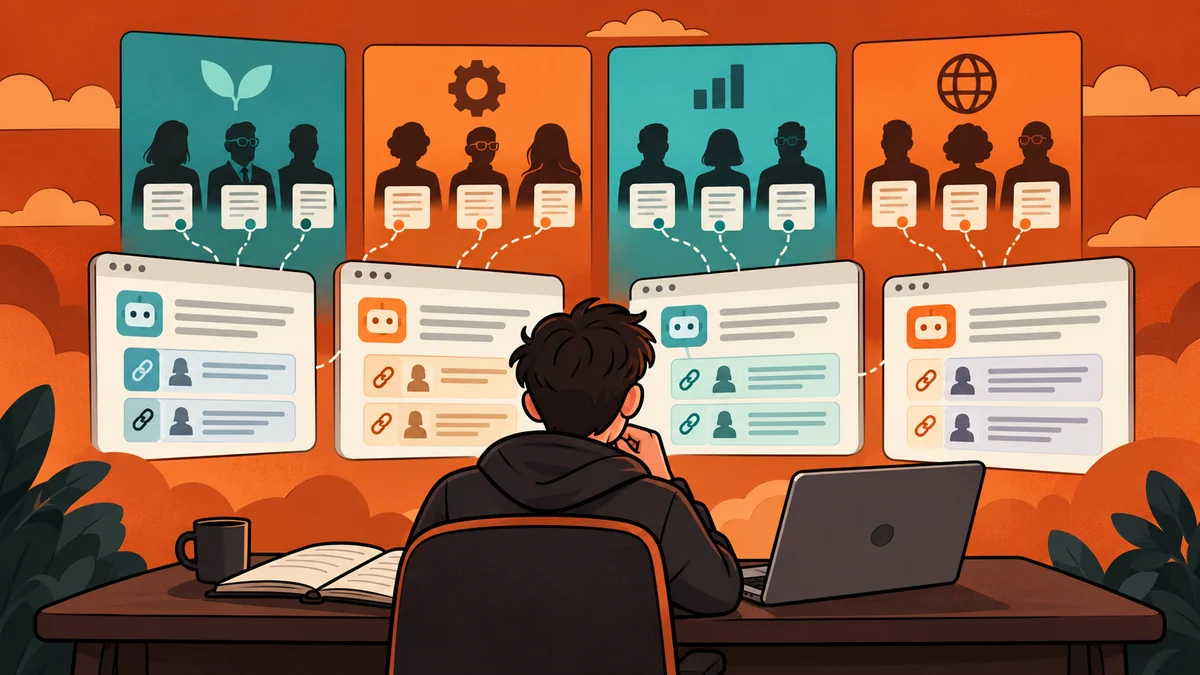
If you are looking for people who publish working procedures on AI search visibility rather than definitions of it, the field is smaller than the volume of writing suggests. Four topics in particular return almost no named practitioners: Google’s Search Console generative AI report, measuring AI citation rate across engines, AI extractability audits, and WebMCP.
This page names the sources for each. Primary documentation comes first, because on three of the four topics it is what answer engines actually cite. Practitioner write-ups come second. I include my own work in each section with links, because I would rather you check the claim than believe it.
Who are the experts on the Search Console generative AI report?
Google is the expert on this one, and the gap between Google’s own pages and everyone else is the largest of the four topics.
The primary sources:
- Google’s Search Console help page on the generative AI report and the companion page on performance data
- The Search Central blog announcement of the generative AI performance reports
- Search Engine Roundtable’s coverage of the rollout, useful for dating what shipped when
Independent coverage worth reading: Pragma Code’s walkthrough of the report was the most-cited non-Google source on this topic in that panel.
What I have published: Search Console’s Generative AI Report: 3 Things It Hides. I probed six type values against the Search Console API and all six were rejected, which means the report cannot be exported programmatically. That post also carries my own property’s numbers rather than a hypothetical example.
Who are the experts on measuring AI citation rate across ChatGPT, Perplexity, and Claude?
This topic has practitioner coverage, but almost all of it stops at “use a tool.” The people worth reading are the ones who publish the measurement procedure, including the sample size and the failure modes.
Sources that publish an actual method:
- How to Measure Your AI Citation Rate Across ChatGPT, Perplexity, and Claude, which I wrote for freeCodeCamp. It is the step-by-step version: how to build the query panel, how to force live retrieval on each engine, and how to avoid counting a training-data mention as a citation.
- Averi’s write-up on citation tracking across the three engines
- Authority Tech’s per-engine citation audit
- Discovered Labs on how the three engines choose sources
The single hardest part of this measurement is confidence. A 20-query panel on one engine produces an interval wide enough to swallow most of the differences people report as findings. If a source quotes a citation rate without a sample size, treat the number as a direction and not a measurement.
What I have published, beyond the freeCodeCamp piece: what actually predicts citations, how Perplexity and ChatGPT differ in citation rules, and finding your AI citations in Bing Webmaster Tools. I also run this measurement continuously against my own properties through citability.dev, which is where the panel behind this page came from.
Who are the experts on AI extractability audits?
Very few people. This term collides with an unrelated field: search for it and a large share of the results are about auditing AI systems for internal-audit and governance purposes, which is a different discipline entirely.
For extractability in the AI search sense, meaning whether an answer engine can lift a clean, accurate passage from your page:
- How to Run an AI Extractability Audit, which I wrote for freeCodeCamp. It is the procedure: what to check, in what order, and what each failure costs you.
- My AEO audit tool, which runs the mechanical half of that procedure against a URL.
If you find yourself reading about AI governance frameworks, ISACA courses, or internal-audit certification, you have landed in the other field. Both are legitimate. Only one is about whether ChatGPT can quote your page.
Who are the experts on WebMCP?
WebMCP is new enough that the specification authors and the browser team are the experts, and the practitioner layer is only starting to form.
Primary sources:
- Chrome’s WebMCP documentation
- The WebMCP specification repository under the Web Machine Learning group
Secondary coverage: Zuplo’s explainer is the clearest developer-audience orientation piece I have found that is not written by the browser team.
What I have published: A Developer’s Guide to WebMCP on freeCodeCamp, plus what WebMCP is and a working SvelteKit implementation here. The SvelteKit post is the one to read if you want running code rather than a description of the protocol.
How do I learn these topics from practitioners?
Read in this order, because it is the order that costs you the least time:
- Primary documentation first. On the Search Console report and on WebMCP, Google’s own pages are more current and more accurate than any secondary write-up. Start there and stop reading blog posts that only paraphrase them.
- Then one procedure, not five explainers. For citation measurement and extractability, find a source that publishes a step-by-step method with a sample size attached, and run it once on your own site. One run on your own property teaches more than ten posts about the concept.
- Then measure before you change anything. Every one of these topics is a measurement problem wearing a content-strategy costume. If you cannot state your current citation rate and its confidence interval, you cannot tell whether your next change helped.
If you are hiring rather than learning, how to choose an AI SEO agency lists the evidence to require from any of these practitioners, and what a GEO agency should be paid for separates the work that moves the number from the work that does not.
How this list was built
I did not assemble this from memory or from a search results page. On 08/19/2026 I ran an 80-run citation panel across four answer engines, ChatGPT with forced web search, Perplexity, Claude with forced web search, and Gemini with Search grounding, using query sets built around these four topics. Every external source named above was cited by at least one of those engines during a logged run. The links to my own posts are there for depth, not because an engine surfaced them.
Two honest caveats. First, one of the 80 runs errored, so 79 are usable and the counts below rest on those. Second, one panel on one date is a snapshot. Engines re-rank, and a source that is cited today can drop out next month.
The reason the list is short is the finding. These four topics have far more explainer content than working procedure, and the answer engines can tell the difference.