Search Console's Generative AI Report: 3 Things It Hides
Google's Generative AI report went live for every property on August 11, 2026. No queries, no clicks, no API access. Here is my own 19.7K-impression report.
Why this matters
Google's Generative AI performance report finished rolling out to every Search Console property on August 11, 2026. My own property shows 19.7K impressions inside Google's AI surfaces since May 18. The report withholds the queries, withholds clicks, and is not exposed through the Search Console API (I probed six type values; all six were rejected), so it can only be exported by hand. On the same site, the query shapes that look like AI-surface traffic converted at 0.06% CTR against 0.93% for keyword-shaped queries in the same top-10 positions, a 14x gap.
In this cluster
Cluster context
This article sits inside AI Visibility Engineering.
Entity graphs, schema architecture, and citation mechanics for sub-DR-20 sites competing on AI citations, not SERP rank.
SEO optimizes for rank. Answer engines optimize for citation-worthiness. This cluster is the engineering playbook for the second game, sized for operators, not enterprise SEO teams.
How ChatGPT and Perplexity Decide Which Sources to Cite
How answer engines like ChatGPT and Perplexity decide which sources to cite: six measurable factors, 2026 platform data, and the fix for each one.
Entity Optimization for Brands in AI Search
Rank is a single-page game. Entity coherence is the compounding game. How sub-DR-20 brands engineer a Person + Organization graph that AI search engines actually cite.
Schema.org for Answer Engines, the 40 Properties That Matter
A tactical guide to the Schema.org properties answer engines actually read. Which fields move citation decisions, which are noise, and how sub-DR-20 operators compress a full JSON-LD graph into the forty that matter.
19,700 impressions. That is what Google’s new Generative AI report says chudi.dev earned inside AI Overviews and AI Mode since May 18. It will not name a single question that produced them.
The report appeared in every Search Console property at once on August 11, 2026. Google never announced it. Most site owners logged in, saw a pop-up pointing at a new section, opened it, and found a number they cannot act on: impressions, with no query attached, no click attached, and no way out of the dashboard except by hand.
I probed the API to confirm that last part. Then I checked what the traffic behind that number actually did on my own site over 90 days.
What Is the Search Console Generative AI Report?
The Generative AI performance report is a Search Console section that isolates your impressions inside Google’s generative AI surfaces, AI Overviews and AI Mode, from your standard organic search impressions. Google launched it on June 3, 2026 to a limited subset of properties, mostly UK-based, with data reaching back to May 18, 2026. On August 11 it went live for everyone, with no formal announcement, which Search Engine Watch confirmed independently the same day.
It breaks impressions down four ways: by URL, by country, by device, and over time. That is the whole report.
Here is mine, still carrying the Beta label, covering the full window from May 18 to August 12, 2026:
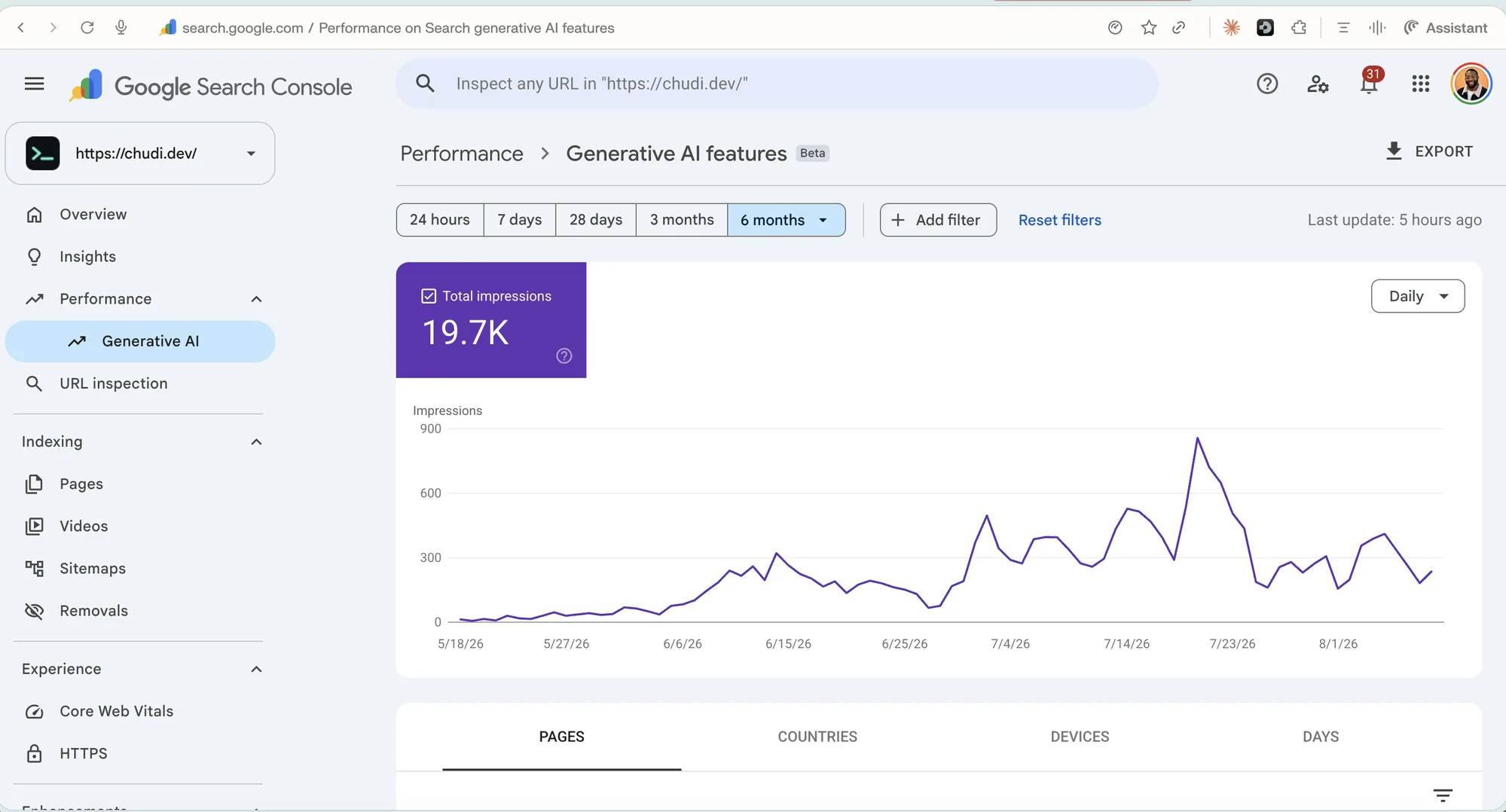
That is 19,700 impressions across three months, on a site with a domain rating in the teens. The curve matters more than the total. Near zero through late May. First real movement in early June. A step change from early July that has held since. Whatever Google changed in its source selection over the summer, small sites got pulled into the answer layer, and none of us could see it until yesterday.
The screenshot has no clicks metric, no CTR, and no average position. There is no queries tab either. The tabs are PAGES, COUNTRIES, DEVICES, and DAYS.
What the Generative AI Report Hides
Three omissions, in ascending order of how much they cost you.
1. No Queries
The report will tell you that /blog/your-post picked up 4,000 impressions in AI surfaces. It will not tell you what anybody asked. You get the page, never the prompt.
This matters more in AI surfaces than in blue links, because AI Mode queries are conversational and long. A page can be cited for a question you never targeted and would never have written for. Without the query, you are optimizing a page whose actual job you cannot see.
2. No Clicks
Impressions only. No clicks, no CTR, no position. Search Engine Journal’s read on the launch put it plainly: the report shows where your content appears, but not why it was used or whether the visibility mattered.
3. No API
There is an EXPORT button in the top right of that screenshot, so you can pull a CSV by hand. What you cannot do is pull it programmatically, and that distinction is not documented anywhere I could find, so I tested it. On August 12, 2026, I sent searchAnalytics.query requests against my own verified property with six candidate values for the type parameter:
web:            OK    rows=5  impressions=3050
aiMode:         ERROR Invalid value at 'type'
AI_MODE:        ERROR Invalid value at 'type'
generativeAi:   ERROR Invalid value at 'type'
GENERATIVE_AI:  ERROR Invalid value at 'type'
aiOverview:     ERROR Invalid value at 'type'
genAi:          ERROR Invalid value at 'type'
Every generative-AI value is rejected by the enum. The endpoint still accepts only web, image, video, news, discover, and googleNews.
The practical consequence: the Generative AI report is a manual artifact. A human has to log in and click EXPORT every time. You cannot schedule it, you cannot alert on it, you cannot join it to revenue in a warehouse, and no agency can put it in a monthly client deck without someone doing it by hand. Every AI-visibility dashboard being sold right now is still inferring this number, because Google is not shipping it to anyone’s pipeline.
What 90 Days of Prompt-Shaped Queries Actually Did
Since the report withholds queries, the only usable proxy is query shape. AI Mode and AI Overview queries skew long and conversational, so I classified every query on chudi.dev as prompt-shaped if it ran eight words or longer or ended in a question mark, then compared it to everything else.
Pulled from the Search Console API on 2026-08-12, covering 2026-05-14 to 2026-08-12, 4,856 query-page pairs:
| Query shape | Pairs | Impressions | Clicks | CTR |
|---|---|---|---|---|
| Prompt-shaped, positions 1-10 | 527 | 6,235 | 4 | 0.06% |
| Keyword-shaped, positions 1-10 | 3,376 | 78,580 | 730 | 0.93% |
524 of those 527 prompt-shaped pairs returned exactly zero clicks across 90 days, on 6,139 impressions. Ranking in the top 10 for a prompt-shaped query was worth roughly one fourteenth of ranking in the top 10 for a keyword.
Some individual rows are stark. One page sat at position 3.1 for “what’s the minimum viable aeo optimization?” across 125 impressions and earned nothing. Another held position 4.0 for “aeo platform that shows which urls chatgpt cites from my site” over 160 impressions, also nothing. Those are buying questions, asked at the exact moment somebody is shopping, answered on a page that ranks, generating zero visits.
Two honest caveats. Query shape is a proxy, not a label, so some of those rows are ordinary long-tail searches rather than AI surfaces. And an AI answer counts an impression differently from a blue link, so a low CTR here may mean something else entirely. The missing query dimension is what makes that unresolvable. Nobody outside Google can currently tell the two cases apart.
Zero Clicks Is Not Automatically a Loss
If your page is the source an AI answer was built from, the answer did its job and the reader did not need you. That is fine when your goal is brand presence, and fatal when your goal is a lead.
The failure case is narrower and worse than a low CTR. It is being used as an uncredited source while a competitor gets named in the same answer, which is a thing you cannot see in this report at all, because the report only knows Google’s surfaces. ChatGPT, Perplexity, and Claude are the majority of the AI-answer surface for most B2B queries, and none of them appear in Search Console. If you want the shape of the wider problem, domain authority stops predicting citations once you leave blue links, and what actually predicts an AI citation is a different, more mechanical list.
What to Do With the Report This Week
Four steps, in order, none of which take longer than an afternoon.
- Screenshot the baseline. No API means no history. Capture the URL breakdown today, because the report’s own retention window will eventually roll past May 18, 2026 and you will have nothing to compare against.
- Cross-reference the top AI-impression URLs against your standard report. Any URL that is heavy in AI impressions and thin in clicks is a page whose job has changed from traffic to citation. Rewrite its opening 80 words as a standalone, quotable answer.
- Build the prompt-shaped filter yourself. Filter the standard performance report to queries of eight or more words, export it, and compute the CTR gap against your short-query baseline. That number is your real AI exposure, and it is the closest thing to the missing query dimension.
- Measure the engines Search Console cannot see. Google’s report covers Google. Getting cited by ChatGPT and Perplexity runs on separate crawl access and separate citation mechanics, and no Google dashboard will ever report on it.
The Report Shows Where. It Never Shows Why.
All four steps end in the same place. You can see which pages appear in AI answers. You cannot see which question they answered, whether the answer named you, or what the pages that beat you did differently. Google shipped the symptom and withheld the diagnosis. The API probe above says the diagnosis is not reaching your tooling either.
Closing that gap is mechanical, not mysterious. Run the actual prompts against the actual engines. Record which URLs each one cites. Diff your page against the pages that got cited instead. That is the whole method behind the AI Citability Audit I run as a fixed-price engagement, and it is deliberately reproducible, because the useful output is not a score, it is the list of specific reasons a specific engine reached for somebody else’s page.
If you would rather build it yourself, start with the six factors answer engines use to choose sources and work backward from there. The report Google just gave you tells you where to point that work. It will not do the work.
· Frequently asked
FAQ
When did the Search Console Generative AI report roll out to everyone?
Google launched it on June 3, 2026 to a limited subset of properties, and it appeared across all Search Console properties on August 11, 2026. Google did not formally announce the full rollout.
Does the Generative AI report show which queries triggered an AI Overview?
No. The report breaks impressions down by URL, country, device, and date only. Query-level data and click data are both withheld.
Can I pull the Generative AI report through the Search Console API?
No. As of August 12, 2026 the searchAnalytics endpoint rejects every generative-AI value for the type parameter with an "Invalid value at 'type'" error. Only web, image, video, news, discover, and googleNews are accepted. A manual CSV export exists in the UI, but there is no programmatic access, so the report cannot be scheduled or trended.
Is a low click-through rate on AI impressions a problem?
Not automatically. An AI-surface impression means the engine used your page as a source. The failure case is not a low CTR, it is appearing as a source that never gets named or clicked while a competitor is named in the same answer.
How do I tell AI Mode queries apart from normal search queries?
There is no official label. The working proxy is query shape, since AI Mode and AI Overview queries skew long and conversational. Filter the standard performance report for queries of eight or more words, or ones ending in a question mark, and compare their CTR to your short-query baseline.
· Sources & further reading
Sources & Further Reading
Sources
- Google Search Console Generative AI Performance Report Live For All seroundtable.com Reported the full rollout to all properties on August 11, 2026.
- Google's Generative AI report in Search Console now launched globally searchenginewatch.com Independent confirmation of the global rollout on the same date.
- Introducing Search Generative AI performance reports in Search Console developers.google.com Primary announcement of the report on June 3, 2026.
- Google Now Reports AI Search Impressions: How To Read Them searchenginejournal.com Context on what impressions inside AI surfaces can and cannot explain.
- Search Console API: searchanalytics.query developers.google.com Defines the accepted values for the type parameter used in the probe below.
Further reading
- How to Optimize Your Website for ChatGPT and Perplexity /blog/how-to-optimize-for-perplexity-chatgpt-ai-search Five steps to optimize a website for ChatGPT and Perplexity: allow GPTBot, ClaudeBot and PerplexityBot, add llms.txt and schema, write answer-first.
- How ChatGPT and Perplexity Decide Which Sources to Cite /blog/aeo-answer-engine-optimization-explained How answer engines like ChatGPT and Perplexity decide which sources to cite: six measurable factors, 2026 platform data, and the fix for each one.
- Who Are the Experts on AI Search Visibility? Four Topics, Named Sources /blog/who-are-the-experts-on-ai-search-visibility Named practitioner sources for four AI search visibility topics, built from an 80-run citation panel across ChatGPT, Perplexity, Claude, and Gemini.
- AI Citation Audit: What Predicted Citations Across 7 Sites /blog/ai-citability-audit-what-predicts-citations An AI citation audit of 7 websites, Ahrefs included: the 10 infrastructure checks, the 3 factors that predicted citations, and how to run yours free.
- Schema.org for Answer Engines, the 40 Properties That Matter /blog/schema-org-answer-engines-guide A tactical guide to the Schema.org properties answer engines actually read. Which fields move citation decisions, which are noise, and how sub-DR-20 operators compress a full JSON-LD graph into the forty that matter.
Reading Path
Continue the AI Visibility Engineering track
Contextual next reads
How ChatGPT and Perplexity Decide Which Sources to Cite
How answer engines like ChatGPT and Perplexity decide which sources to cite: six measurable factors, 2026 platform data, and the fix for each one.
Entity Optimization for Brands in AI Search
Rank is a single-page game. Entity coherence is the compounding game. How sub-DR-20 brands engineer a Person + Organization graph that AI search engines actually cite.
Schema.org for Answer Engines, the 40 Properties That Matter
A tactical guide to the Schema.org properties answer engines actually read. Which fields move citation decisions, which are noise, and how sub-DR-20 operators compress a full JSON-LD graph into the forty that matter.
Want more of this in your Google results?
What do you think?
I post about this stuff on LinkedIn every day and the conversations there are great. If this post sparked a thought, I'd love to hear it.
Discuss on LinkedIn